

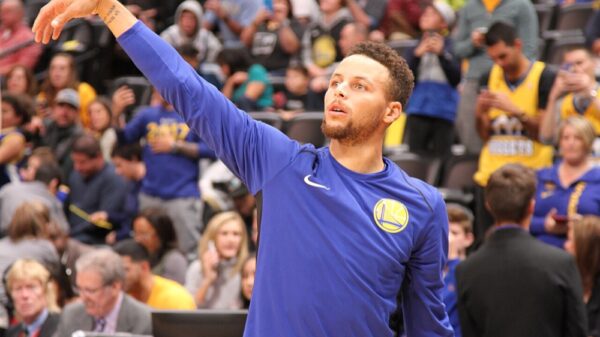





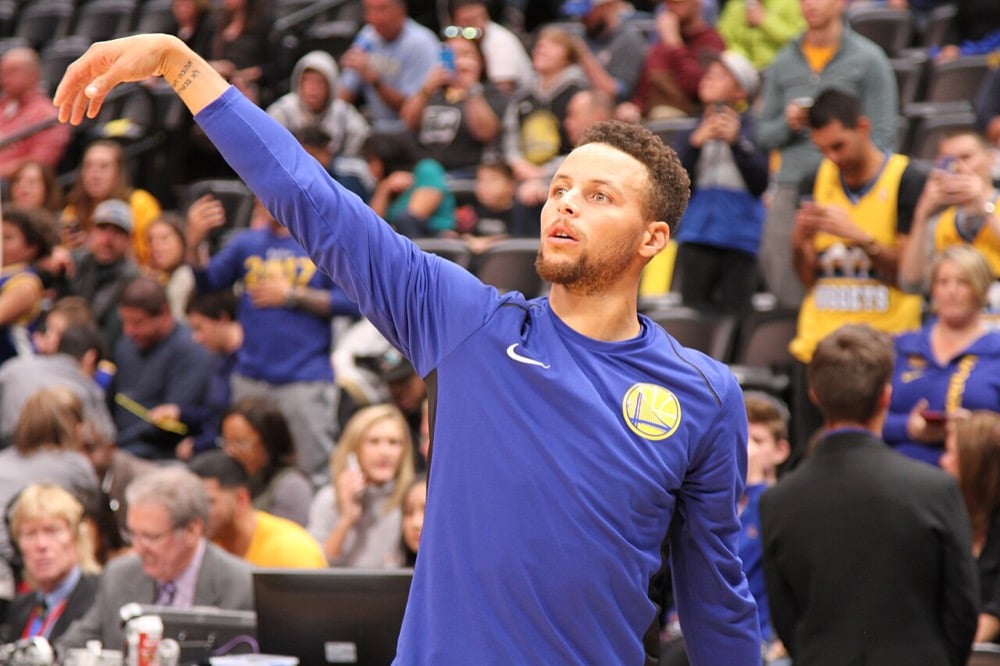
Given what Stephen Curry has established in Golden State throughout the past decade and more, it is easy to overlook the franchise’s less glamorous historical eras. However, the squad has recently carved out a modern stretch of ineptitude that stands out even by those historical standards.
Following a competitive defeat against the Houston Rockets—a game that saw Curry exit in the opening quarter due to an oblique injury—the Warriors dropped four consecutive contests by margins of 20 points or more. This marks only the second instance of such a streak in franchise history, echoing a bleak February 1998 period that followed the infamous Latrell Sprewell and P.J. Carlesimo incident. That previous four-game skid carried a combined point deficit of 104.
The current slump is even more severe, featuring a 109-point negative differential across four games. The drop-off feels especially jarring when contrasted with the eight-game winning streak the team put together right before Curry went down. By comparison, the 1997-98 roster struggled heavily from the jump, opening 1-14 and securing only 19 victories overall without ever stringing together more than three wins in a row.
Conversely, the modern roster was trending toward genuine playoff contention. While skeptics might point to a favorable stretch in the schedule, that argument loses steam when considering the victims during that eight-game run included the Denver Timberwolves, Los Angeles Lakers, Miami Heat, Denver Nuggets, and an Orlando Magic squad that subsequently won five of six.
Perhaps a full-strength Warriors lineup still would have fallen to a strong San Antonio Spurs team, or stumbled against the New Orleans Pelicans, Dallas Mavericks, and Memphis Grizzlies. That outcome seems unlikely, but regardless, this squad has never been dominant enough to treat any matchup as an automatic win. That is not the central issue.
The real concern lies in how thoroughly uncompetitive they have looked during these recent losses. Dropping four straight by at least 20 points while failing to crack the 100-point threshold in any of them represents a level of offensive and defensive breakdown that has eluded every other NBA franchise so far this century.
Does Curry’s Absence Serve As His Ultimate MVP Argument?
Before exploring that possibility, it is worth acknowledging that Curry realistically holds little to no chance of capturing his third MVP trophy this season. The Warriors’ overall record will almost certainly fall short of the standard required for serious contention, and his traditional counting statistics—impressive as his early-season output was—will struggle to rival the production of players like Luka Dončić or Victor Wembanyama.
A legitimate path to the award would likely require top contenders to miss the 65-game threshold. Yet, with Curry already sidelined for multiple games and facing an evaluation timeline extending toward late November, reaching that mandatory 65-game mark appears nearly out of reach. He could potentially surpass the maximum allowable missed games limit before stepping back onto the floor.
The real question, therefore, is not whether an 18th-year veteran at age 38 will take home the hardware, but whether he remains the most valuable player in the league. The simplest answer to that query may very well be found by observing how drastically the team collapses without him.
| Eight-game win streak with Curry | 122.2 (1st) | +16.4 (1st) | 60.1 (1st) | 64.0 (1st) |
| Four-game losing streak without Curry | 95.1 (30th) | -27.4 (30th) | 43.4 (30th) | 48.1 (30th) |
Admittedly, those statistical splits involve some selective framing. Curry sat out for one of the victories during that eight-game surge, where Golden State still managed to defeat the Los Angeles Clippers 124-112 behind a stellar 37-point performance from rookie Yaxel Lendeborg and a 122.8 offensive rating.
It is also fair to mention the November 11 matchup against Houston where Curry logged just six minutes, during which the Warriors held their own against an elite opponent. Furthermore, Golden State dropped their first three games of the campaign with Curry active, initially resembling the struggling outfit many analysts predicted.
Even so, the overarching trend remains consistent: the Warriors’ fortunes rise and fall with Curry. That dynamic held true even during championship seasons alongside Kevin Durant and Klay Thompson, where lineup tracking data consistently highlighted Curry as the engine behind the success.
“If I didn’t have Steph, I would’ve been like every other NBA coach and lasted a few years [with the Warriors] and then gone and coached somewhere else,” Steve Kerr once noted, acknowledging that Curry’s presence is the primary dividing line between a standard coaching tenure and a Hall of Fame career.
The historical record supports that assessment.
| Kerr with Curry | 528-218 | 70.6% |
| Kerr without Curry | 88-142 | 38.3% |
Even if you exclude the 2019-20 campaign—when Durant departed, Thompson missed the entire year, and Curry appeared in only five contests—Kerr’s record dips below .500 at 74-96 when his star point guard is unavailable. Despite managing numerous elite talents over the years, Kerr’s ultimate success has always depended on Curry’s availability.
That dynamic is just as visible today as the team hits a wall without its leader. With Curry on the court this season, Golden State boasts a 59.6 effective field goal percentage that would rank first in the league. Without him, that figure plummets to 49.1 percent, which would sit dead last.
The defensive slippage during his absence also traces back to offensive struggles. Lacking his floor-spacing and playmaking, the Warriors generate fewer quality looks, miss more shots, and consequently scramble back in transition roughly 3 percent more often. This shift has yielded nearly five additional fast-break points surrendered per game during this stretch.
Golden State has averaged a paltry 103.8 offensive rating in games without Curry this year, a mark that would rate as the league’s second-worst. According to Cleaning The Glass, the Warriors are 26.3 points per 100 possessions better when Curry is on the court. For context, the Lakers see a 25.5-point drop when Dončić rests, while Wembanyama commands an astronomical 37.8-point swing for the Spurs.
Wembanyama undeniably anchors San Antonio’s defense to a comparable degree, and the Lakers’ offensive reliance on Dončić—even with secondary contributors like Austin Reaves—demonstrates elite value. All three are bona fide MVP candidates.
However, true value is singular, and the reality is that organizations like the Lakers and Spurs feature far more self-sufficient rosters away from their headliners. In Golden State, alternative options for creating consistent offensive leverage, defensive gravity, or shot generation are virtually nonexistent.
Following a 38-point blowout loss to the Spurs sans Curry, rookie Yaxel Lendeborg—unfairly thrust into an expanded scoring role—remarked that “it felt helpless out there,” capturing the exact sensation that defines the Warriors’ current post-Curry reality.
To be fair, evaluating a star’s worth strictly through their absence is an imperfect exercise. Systems built precisely around a singular talent like Curry’s ecosystem are notoriously difficult to adjust on the fly, meaning the supporting cast is likely not as inept as their recent four-game skid suggests.
At the same time, they are nowhere near as potent as they appear when Curry is healthy. It is a common phenomenon in sports for supporting players to look exceptional next to a generational talent, only for the team to struggle profoundly once that catalyst is removed.
From a purely basketball perspective, Curry’s impact goes beyond individual scoring; his exponential gravity elevates everyone around him. While it remains to be seen whether the Warriors can adapt during his extended recovery, watching the team struggle so severely makes a strong case that Curry remains the most valuable player in basketball.
In summary, the Golden State Warriors’ recent struggles highlight just how much their success relies on Stephen Curry. While metrics and individual accolades often dictate MVP conversations, watching the team’s dramatic drop-off on both ends of the floor without him underscores his unparalleled value to the franchise.