






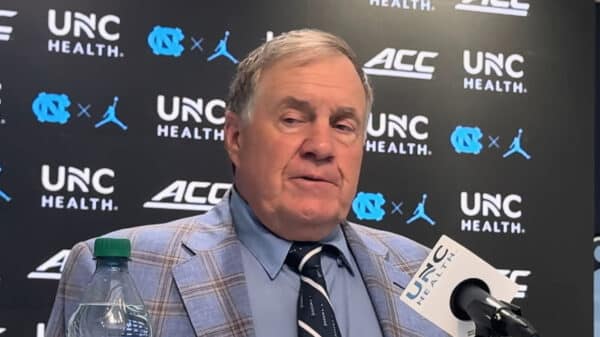



In the realm of college sports, the Big Ten Conference made quite a splash by awarding former commissioner Kevin Warren a hefty $5.75 million bonus in the 2024 fiscal year. This recognition marked his pivotal role in securing a groundbreaking $7 billion media rights deal, a monumental achievement by any standard. Yet, when we compare that bonus to the eye-popping $20 million retirement package bestowed upon his predecessor Jim Delany, who orchestrated the earlier media rights agreement, it puts things in perspective. Warren’s payout is substantial, but it certainly doesn’t hold a candle to the legacy left by Delany.
According to the Big Ten’s recent IRS filing, as reported by Sportico, the conference raked in an impressive $928 million in revenue during FY24—right on the cusp of that coveted billion-dollar mark. This figure stands nearly $90 million ahead of the Southeastern Conference, a significant achievement. However, the expenses were substantial, totaling around $942 million. Member schools, feeling the financial effects of the new media rights deal, found their distributions ranging from $61.5 million to $63.6 million. As the full benefits of this lucrative deal begin to materialize, the Big Ten is on track to comfortably eclipse that billion-dollar threshold next year, which is exciting news for schools and fans alike.
Warren’s total compensation for FY24 hit $6.83 million, a combination of his salary and bonus. In stark contrast, Delany, despite stepping back in 2020, still managed to claim $2.97 million in deferred compensation along with $400,757 in consulting fees last year. The current commissioner, Tony Petitti, meanwhile, reported a total of $2.6 million for his first year, including a $500,000 bonus, which is freshly disclosed for public viewing.
The first to break this news was USA Today, bringing the conference’s financial dealings into the public eye.
Interestingly, Warren, who has since become the president of the Chicago Bears, opted not to comment on his bonus when contacted via text, attributing his silence to ongoing travel commitments.
Warren’s tenure at the Big Ten was nothing short of dramatic, lasting just 40 months before he transitioned to his role with the Bears. Throughout those months, there was a palpable tension regarding how much credit—and therefore how much cash—Warren should receive for the monumental media deal. This debate often felt like a tug-of-war between the differing factions that originally supported Delany’s long-time leadership and Warren’s brief but impactful reign.
Supporters of Delany often argue there should be no question over the comparison; how could the achievements of a commissioner who led the conference for three decades—expanding it to 14 members and launching the Big Ten Network—be measured against that of someone who was only in office for three years and then opted to return to the NFL? Conversely, Warren’s advocates contend that he brought a unique perspective that was crucial during the tumultuous COVID-19 pandemic, steering the conference through uncharted waters and successfully orchestrating the high-stakes addition of two prominent Pac-12 teams while securing the most lucrative media deal in college sports history. It’s a classic case of differing perspectives.
Delany’s longstanding influence loomed large over Warren’s time as commissioner, a period that ushered in notable changes for a conference that had become accustomed to a more stable landscape. Warren’s attempts to innovate were met with mixed results; for instance, his initiative to create the Big Ten’s first in-house general counsel position led to two hires within just two years before finally settling on Anil Gollahalli, who currently holds the position. In FY24, Gollahalli was the highest-paid employee of the Big Ten outside of the two commissioners, earning $517,907—a testament to the increasing complexity of college athletics.
Notably, the Big Ten also invested heavily in outside legal services during the last fiscal year, spending a whopping $7.02 million in a climate rife with litigation in college sports. Two law firms, Mayer Brown and Sidley Austin, were among those receiving seven-figure payouts, with Mayer Brown garnering $3.8 million and Sidley Austin $1.3 million for their services.
In an interesting move, Warren recruited the Big Ten’s chief financial officer, Laura Anderson, to join him with the Chicago Bears as its CFO. Anderson’s salary for FY24 was $397,865, showcasing her value within the financial realm of sports management.
Unlike Warren, Petitti—who was brought on in May 2023—seems to prefer the tried-and-true approaches of Delany’s era. He’s retained Delany as an external consultant and has brought back deputy commissioner Diane Dietz, aiming to instill some continuity within the conference.
Image Source: Kevin Warren @ Instagram