






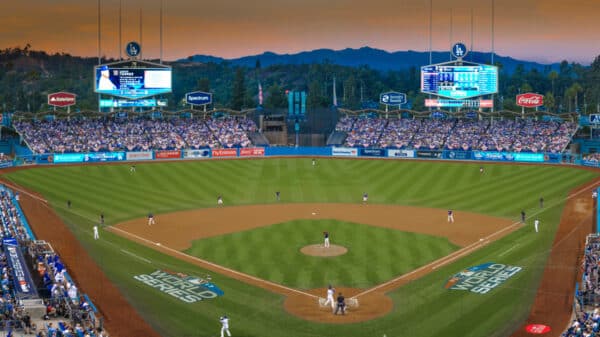


The Los Angeles Dodgers have become quite adept at crafting deferred contracts, turning what could be a tedious financial strategy into a hallmark of their team management approach. Currently, they manage a staggering $1.01 billion in deferred contracts spread across eight players. Among these, a substantial $680 million is allocated to superstar Shohei Ohtani, while pitcher Blake Snell, infielder/outfielder Tommy Edman, and reliever Tanner Scott also benefit from smaller deferred amounts after signing with the Dodgers last offseason.
Bobby Bonilla, a former Major League Baseball outfielder, is perhaps the quintessential example of the deferred contract phenomenon. Known for one of the most infamous deferred deals in baseball history, Bonilla views the Dodgers’ financial maneuvering as a “beautiful thing.” “It’s a reminder that I did the right thing by putting the money away,” he said, reflecting on the long-term planning that these deals promote.
Every July 1, Bonilla celebrates what he calls his biggest day of the year—a day that has become almost legendary in sports culture. On this date, he receives a $1.2 million payment from the New York Mets, part of a deal that constitutes the 15th of 25 payments extending through 2035. “It’s bigger than my birthday,” Bonilla chuckled during a phone interview from his home on Florida’s west coast. “People know this date more than they know my birthday. I think it’s very cool. People are just happy that I put the money aside.” For the record, his birthday is February 23, and he’s currently 62. Although Bonilla’s career ended in 2001, he is more widely recognized for his deferred contract than for his impressive stats of 287 homers and a .279 batting average throughout his 16 seasons with eight teams.
Bonilla’s contract, arranged by his then-agent Dennis Gilbert, was initially a solution for the cash-strapped former Mets owner Fred Wilpon. However, it turned out to be an even better deal for Bonilla, who stands to collect roughly five times the $5.9 million cash value remaining on his original contract, thanks to an 8% interest rate. He first reaped the benefits of this smart investment strategy in 2011 and is set to enjoy $1,193,248.20 annually from the Mets until he turns 72.
Raised in the Bronx, Bonilla emphasizes that he never felt the need to splurge extravagantly during his playing days. The deferred payments were not a safety net against reckless spending; rather, they were a prudent way of ensuring his financial security post-retirement. “It was just being sure I put money away,” he explained. “I wasn’t that much of a big spender. I never needed five of the same car or 17 houses. I never overdid anything. But the most important thing with Dennis, and I expressed that as a young player, I just wanted to have when I retired.”
While Bonilla was not the first player to enter into a deferred contract, his name often surfaces in discussions about the topic. The San Diego Padres were pioneers in the 1980s, offering deals to players like Garry Templeton and Goose Gossage tied to annuities. Notably, reliever Bruce Sutter signed a six-year, $9.1 million contract with the Braves in 1984 that would ultimately pay him $47 million due to a hefty 12.3% interest rate.
According to MLB regulations, teams must treat deferred money as if it were being paid out in real-time. This method has advantages not just for players but also for clubs, especially when it comes to managing salary cap spaces and luxury taxes. For instance, among the Dodgers’ lucrative deals since signing Mookie Betts in 2020, the team has issued $207 million in bonuses, most of which were paid upfront. Ohtani, however, received no signing bonus at all.
As far as the luxury tax is concerned, deferred payments get discounted annually during the contract’s lifespan. Bonuses, on the other hand, are amortized yearly, making them less burdensome in one fell swoop. To illustrate, Ohtani’s $70 million contract over ten years counts as only $41.6 million against the Dodgers’ luxury tax because of the decreasing dollar value from deferral.
In hindsight, Bonilla gets a lot of credit for popularizing this financial strategy among players. “A lot of times they call it the greatest contract of all time in a lot of people’s minds,” he stated. “It wasn’t the first of its kind. I’m not going to say that before me people didn’t put money away. And now Dodgers players are doing it to their advantage. But my contract got particular traction, maybe because of the circumstances. It’s a fun day.” His story serves as a reminder of the long-term thinking that can benefit players and organizations alike—a relevant lesson for anyone charting their own financial future.